
The monument commemorates the 1969 Stonewall Uprising that sparked the modern LGBTQ+ rights movement
Spencer Platt/Getty
NEED TO KNOW
- A group of N.Y.C. elected officials raised a Pride flag at the Stonewall National Monument on Thursday, Feb. 12 after a previous Trump Administration directive led to its removal
- The Stonewall Monument in N.Y.C’s Greenwich Village commemorates the birthplace of the modern LGBTQ+ civil rights movement
- Former President Barack Obama established the site as a national monument in 2016
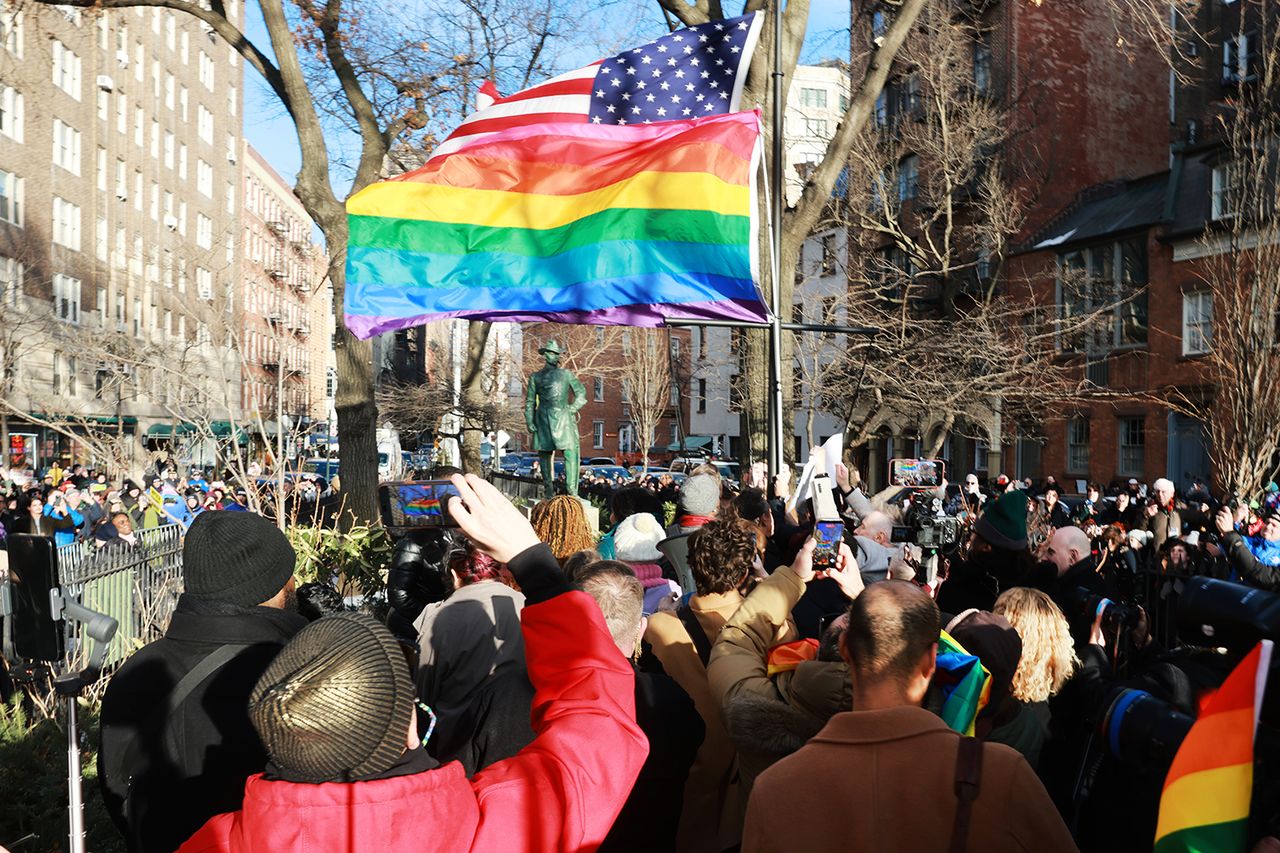
New York City officials raised a Pride flag outside the Stonewall National Monument on Thursday, Feb. 12, after President Donald Trump's administration had the flags removed.
Several elected officials gathered at the Greenwich Village monument to speak out against the Trump administration's ongoing directives against diversity and inclusion programs. The Stonewall National Monument, a historic site in the history of the LGBTQ+ rights movement, was established at the site of The Stonewall Inn by former President Barack Obama in 2016.
“The most Stonewall thing that we could possibly do is put that flag back up ourselves instead of waiting for the president,” Councilman Chi Ossé, a co-chair of the City Council’s LGBTQ+ caucus, said at a press conference, The New York Times reports.
Manhattan borough president Brad Hoylman-Sigal said the rainbow Pride flag would once again rise on the flagpole at 4 p.m. local time, “in the memory of those whose shoulders we stand on, who fought for L.G.B.T. equality and who pointed the direction forward for generations of queer Americans," The Times reports.
Julie Menin, the Council speaker, said the Pride flag “was taken in the middle of the night.”
“There was no discussion,” she said on Thursday, according to The Times. “There was no warning. It was taken.”
The Trump administration ordered the flag's removal on Jan. 21, according to The New York Times and CBS News.
The historic monument in the Greenwich Village neighborhood of Manhattan marks the birthplace of the modern LGBTQ+ civil rights movement. It commemorates the 1969 Stonewall Uprising, a six-day period of protests against police raids at the nearby Stonewall Inn, a bar that served as a refuge for LGBTQ+ patrons at a time when homosexuality was illegal. The Stonewall Uprising was considered a catalyst for the modern gay liberation movement, and kicked off the tradition of annual Pride marches in the U.S. in June.
Hoylman-Sigal, 60 — who made history on Jan. 1 when he became New York's first gay borough president — posted about the incident, saying, "They cannot erase our history. Our Pride flag will be raised again. Stay tuned."

Spencer Platt/Getty
In a statement shared with PEOPLE on Tuesday, Feb. 10, the National Park Service cited "government-wide guidance" in saying that “only the U.S. flag and other congressionally or departmentally authorized flags are flown on NPS-managed flagpoles, with limited exceptions. Any changes to flag displays are made to ensure consistency with that guidance."
NPS insisted that the "Stonewall National Monument continues to preserve and interpret the site’s historic significance through exhibits and programs."
Never miss a story — sign up for PEOPLE's free daily newsletter to stay up-to-date on the best of what PEOPLE has to offer, from celebrity news to compelling human interest stories.
Timothy Leonard, the northeast program manager for the National Parks Conservation Association, told PEOPLE in a statement that "the symbolic and meaningful representation of the Pride flag at Stonewall is at the heart of American history told and celebrated here."
"Given the Department of Interior’s own guidance, the Pride flag is undoubtedly part of the living history and historical significance connected to Stonewall National Monument," Leonard added. "And it should remain."
Read the full article here