




The honor of becoming the living mascot was bestowed upon a lone cub caught in a wildfire in New Mexico
Credit: FPG/Hulton Archive/Getty; David Pollack/Corbis via Getty
NEED TO KNOW
- The U.S. Department of Agriculture (USDA) Forest Service’s Smokey Bear campaign first emerged in 1944
- Then, in 1950, the agency was able to name a lone cub after the bear, giving the icon a living mascot
- Smokey Bear was rescued from a 1950 wildfire in New Mexico before he was moved to the National Zoo, where he remained the campaign’s mascot until his retirement in 1975
Smokey Bear has been asking the public to help prevent wildfires for over eight decades, and early in the fire prevention campaign, one lone cub became the living icon.
Before the famous icon had a face, the Smokey Bear campaign emerged in 1944, when the U.S. Department of Agriculture (USDA) Forest Service and the National Association of State Foresters worked to produce fire-safety public service announcements (PSAs), according to the Smokey Bear website.
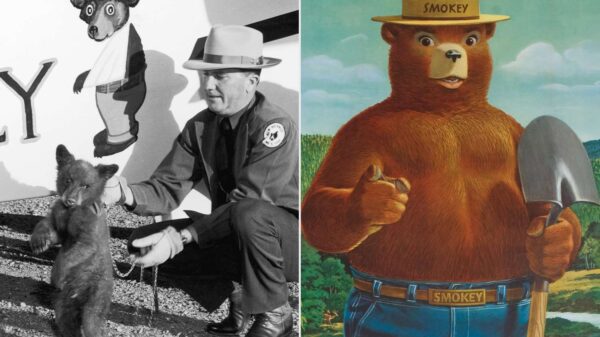
While artist Albert Staehle created the first poster of Smokey Bear, illustrator Rudolph “Rudy” Wendelin drew the popularized image of Smokey Bear in 1946 and became his formal “caretaker” until 1973.
Smokey’s image continued to evolve after a lone cub emerged from a major wildfire in the Capitan Mountains of New Mexico in 1950.

Credit: Alamy
In May 1950, emergency crews were alerted that a lone bear cub was roaming around the fire line, according to the Smokey Bear website. The group of nearly 30 firefighters waited for the cub’s mother to return, but were instead caught in the fire for over an hour. All of the firefighters survived after staying low and lying face down on a rockslide.
Meanwhile, the small animal found safety in a tree. Although he survived, he was badly burned and taken into the firefighters’ care, and New Mexico Department of Game and Fish ranger and pilot Ray Bell transported him to be treated by a veterinarian in Santa Fe, N.M.

Credit: Getty
Never miss a story — sign up for PEOPLE’s free daily newsletter to stay up-to-date on the best of what PEOPLE has to offer, from celebrity news to compelling human interest stories.
“Bell took the cub home, where his wife Ruth and daughter Judy helped nurse the cub back to health and regain his playful energy,” according to the website.
The cub’s story became national news, prompting the public to formally name him after the PSA campaign.

Credit: Robert Alexander/Archive Photos/Getty
His newfound fame brought him from New Mexico to the National Zoo in Washington, D.C., where he became the living symbol of Smokey Bear. During his tenure, he received his own zip code (20252) from the U.S. Postal Service.
While at the National Zoo, another bear, Goldie, was introduced in 1962. Their close bond earned her the title of Smokey’s “wife.” Eventually, in 1971, another orphaned cub joined the pair and was named Little Smokey (aka Smokey II), according to the Smithsonian.
Smokey stayed the living symbol until his retirement in 1975, and lived at the zoo until his death in November 1976. He was buried at the Smokey Bear Historical Park in Capitan, N.M. Smokey Bear II began his time as the second living Smokey in 1975 until his death in August 1990.
Read the full article here